Three Days with the Range Rover Autobiography and Sport Hybrid
In early 2023 I drove both the new-generation L460 Autobiography (V8, 530 PS) and the L461 Sport P440e hybrid for three days around Flensburg, Germany. This is my honest read — what the data said, what the road confirmed, and which one I'd actually choose.
Three Days. Two Cars. Flensburg.
Through BF Analytics, I had three days with both new-generation Land Rover flagships — the full-size L460 Autobiography with the BMW V8, and the L461 Sport P440e hybrid. City, motorway, and everything in between. Northern Schleswig-Holstein: exactly the conditions that test what luxury actually delivers.
The V8 was always going to be the heavier, quieter, more theatrical machine. The Sport Hybrid was supposed to be the sharper, more driver-focused one. Three days later, the reality was more nuanced than that.
The Two Cars — What They Are on Paper
First Impressions — Before Driving a Metre
Standing next to the Autobiography in the morning light, the first thing you register isn't the size — it's the composure. The L460 is a genuinely big car (nearly 5 metres long, just under 2 metres wide) but Land Rover's designers have pulled every visual trick to compress it. The flush door handles, the near-invisible A-pillars, the flush-fit glass — it looks more like a concept car than something you can buy. Next to the outgoing generation, it's not an evolution. It's a different philosophy.
The Sport sits alongside it and immediately reads as the more athletic sibling. Same design language, but with an additional 200 mm stripped from the roofline. Where the Autobiography's roofline flows back gently and luxuriously, the Sport's is more purposefully raked. In certain light — and particularly in the darker colours — it looks genuinely aggressive for a Land Rover product.
Inside the Autobiography, the cabin is one of the quietest and most considered interiors in the luxury SUV segment. The Autobiography specification adds a four-seat executive configuration with a full centre console in the rear, individual rear seat adjustment, and a refrigerated compartment. Land Rover calls it a "Lounge Seat" configuration and the name is appropriate. The rear of that car is more comfortable than business class on most European airlines.
The Sport interior is premium but immediately more driver-oriented — slightly lower seating position, more aggressive bolstering, the controls feel tighter and more deliberate. You sit in the Sport. You recline in the Autobiography.
Behind the Wheel — Range Rover Autobiography V8
The P530 V8 is a BMW-sourced engine — the same unit (N63/S68 family) that powers the BMW X7 M60i, the 7 Series 760i, and the Rolls-Royce Ghost. In the Range Rover it's been tuned for a different character: less willingness to scream at high revs, more insistence on overwhelming you in the mid-range. You don't feel like you're wringing power out of it. You feel like it has already decided to go and is simply waiting for you to keep up.
"You don't feel like you're wringing power out of it. You feel like it has already decided to go."
At motorway speeds, the Autobiography is — and I don't use this word easily — serene. The air suspension irons out road imperfections before they reach the cabin. Wind noise is almost absent. The dual-pane glass works. At cruising speed, the cabin is quieter than most road cars you'd encounter at that velocity.
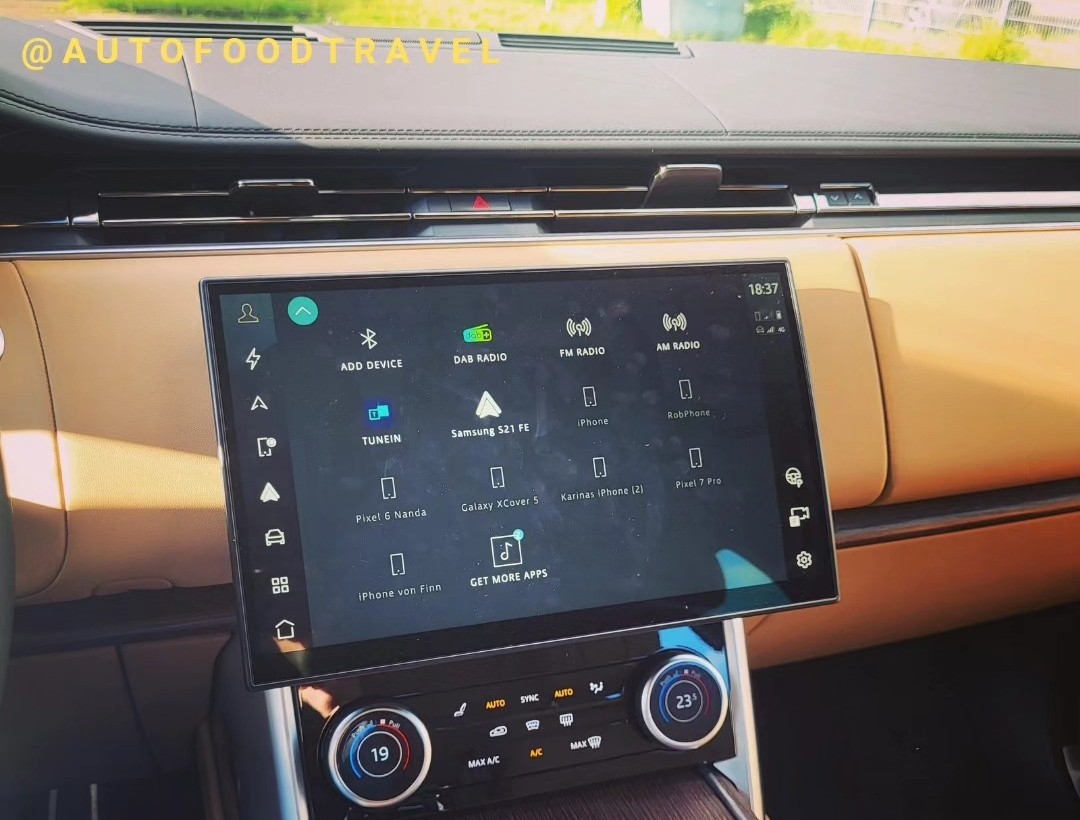
The Pivi Pro infotainment system is the best I've used in any Land Rover product. The 13.7-inch touchscreen is fast, the menus are logically structured, and — crucially — the physical climate controls have been retained as a separate row below the screen. Jaguar Land Rover learned from the pure-touchscreen mistakes of the 2016–2019 generation. Here, you can change temperature without looking away from the road.
The one honest criticism of the Autobiography: it's heavy. At roughly 2,500+ kg it is a significant mass to manage. In town, particularly in tight Flensburg streets, the turning circle and the width demand your attention. It doesn't feel like a penalty when you're cruising — but it makes itself known the moment you need to do something quick.
Behind the Wheel — Range Rover Sport P440e Hybrid
The Sport starts in full EV mode when there's charge. Pull out of a parking space and it's completely silent — which is a surreal experience for something this size. The 31.8 kWh usable battery gives a realistic EV range of around 70–75 km in mixed driving. For a working day in the city, or a commute under 50 km, you'd barely use the combustion engine at all.
The transition from electric to combustion is seamless — better than any other PHEV I've driven. The inline-6 Ingenium engine wakes up without drama or hesitation. Combined output of 440 PS and 620 Nm means it's not noticeably slower than the V8 in everyday driving — the electric motor's torque masks the displacement difference completely below 120 km/h.
"The Sport is the one you'd want to drive. The Autobiography is the one you'd want to be driven in."
Where the Sport impresses most is in direction changes. The shorter wheelbase (252 mm less than the full RR) and slightly stiffer suspension tune makes it feel genuinely agile — not "agile for a large SUV" but agile in an absolute sense. Through sweeping bends, the Sport felt composed and confidence-inspiring in a way the Autobiography — which is more focussed on absorbing the road than engaging with it — simply doesn't try to be.
Head to Head — What Actually Matters
| Dimension | Range Rover Autobiography V8 | Range Rover Sport P440e | Winner |
|---|---|---|---|
| Motorway cruise comfort | Benchmark-setting. Near-silent cabin. Air suspension absorbs everything. | Excellent — but the shorter wheelbase means slightly more movement on surface changes. | Autobiography |
| Driver engagement | Not the point. You can feel the capability but it doesn't invite you to use it. | Genuinely engaging. Shorter wheelbase, stiffer tune, quicker steering response. | Sport |
| In-town usability | The width and weight demand attention. Tight streets are a task. | Noticeably easier — shorter, lighter, electric mode silences the mechanicals. | Sport |
| Rear seat experience | Executive-class. Four-seat lounge config, refrigerator, individual recline. | Good, but a row behind — the Sport prioritises the driver, not the passenger. | Autobiography |
| Daily running cost (fuel) | V8 consumption: ~14–18L/100km. At German fuel prices, significant. | EV mode for city driving. Combustion mainly for longer distances. ~3–4L/100km in mixed use if charged daily. | Sport |
| Residual value (3 year / 60K km) | ~38–42% residual. V8 WLTP disadvantage in EU regulation environment. | ~44–48% residual. PHEV status gives fleet/tax advantages, supports resale in Germany. | Sport |
| Visual presence | Commanding. The full RR silhouette is immediately recognisable at any distance. | Sporty and purposeful — but the Sport has always lived in the full RR's shadow. | Autobiography |
| Technology / infotainment | Pivi Pro, 13.7″. Meridian audio. Fully connected. | Identical Pivi Pro system. Same tech, same quality. | Draw |
The Residual Value Angle — Two Powertrains, Two Different Stories
The Verdict — Which One to Buy
For most buyers — including anyone who drives themselves — the Range Rover Sport P440e is the right choice. It's more engaging to drive, more practical in cities, cheaper to run daily, and holds its value better at resale. The 90 km EV range covers most of what German urban and commuter driving demands, and the combined 440 PS means you never feel the difference between this and the V8 except on the Autobahn above 180 km/h.
The Autobiography V8 is a statement car. It is the most comfortable way to cover ground at speed in a personal vehicle short of a Bentayga or a Cullinan. If you're frequently in the back — if the car comes with a driver, or if your journeys are long enough that you stop driving and start working — then the Autobiography's rear cabin is genuinely unmatched in its class. For that specific use case: it's worth every euro of the premium.
For everyone else: the Sport does everything the Autobiography does, costs less, runs cheaper, and keeps more of its value when you sell it. The analysis pointed this way. The drive confirmed it.
Test Drive Review by Yuvaraj Devadoss · BF Analytics, Flensburg 2023
← Back to portfolio